
Travel Tips for Your African Adventure
Everything I tell my families before they fly.
Before you fly
Visas and entry requirements
Most destinations are relatively easy to enter but the requirements differ country to country, and they do change. Several countries have moved to online travel authorisations you must apply for before you fly, so this is one to sort early rather than at the airport.
Many countries require your passport to be valid for at least six months beyond your travel dates and to have enough blank pages (two or more per country you visit). If you're crossing borders on a multi-country safari, each leg may have its own rules. When you travel with children, some countries, South Africa among them, can ask to see a full/unabridged birth certificate showing both parents, and a consent letter if a child is travelling with only one parent or a guardian.
| Destination | Typical system for many travellers | Sort it |
|---|---|---|
| Kenya | Electronic Travel Authorisation (eTA), applied online in advance | Before you fly |
| Tanzania (incl. Zanzibar) | eVisa online; Zanzibar requires proof of travel insurance | Before you fly |
| Uganda & Rwanda | eVisa online; East Africa Tourist Visa covers Kenya + Uganda + Rwanda together | Before you fly |
| South Africa | Visa-exempt for many nationalities (up to 90 days); others apply in advance | Check by passport |
| Namibia, Botswana, Zambia, Zimbabwe, Mozambique | Mix of visa-free, visa-on-arrival and e-visa depending on passport; Zambia/Zimbabwe offer a KAZA UniVisa on some routes | Check by route |
Requirements depend on your passport and your exact route and they can shift without much notice. I check every family's entry requirements as part of planning, flag the paperwork, and hand you a clear checklist with your journey pack.
Health and vaccinations
None of this should put you off. Millions of families travel to Africa healthy and happy every year. A little preparation makes it a non-event.
See a travel clinic or your GP 6–8 weeks before you go so that there's time for any vaccine courses. They'll provide advice based on your exact itinerary and your family's ages and medical history. Commonly discussed vaccines include routine boosters, Hepatitis A, and Typhoid. Yellow fever is the important one for cross-border safaris: several countries require a yellow fever certificate if you're arriving from or have recently passed through a country where it's present, so the order of your itinerary matters.
Malaria exists in many safari areas (parts of the Kruger, the Zambezi, the Serengeti and more), and the standard advice is antimalarial tablets plus good mosquito-bite prevention: repellent, long sleeves at dusk, and the nets your lodge provides. Reassuringly for families, some of the most-loved regions are malaria-free or very low risk, including Cape Town, the Garden Route, the Cape winelands and several private reserves, which makes them excellent choices for a malaria-free family safari with young children. A few practical extras: stick to bottled or filtered water in most areas and check with your lodge; pack a small family medical kit (rehydration sachets, child paracetamol, plasters, any prescriptions in original packaging with a copy of the script); and bring high-factor sun protection and hats, the African sun is stronger than it feels. We only use SPF 50 sun cream as a family.
I'll tell you which parts of your route carry a malaria risk and which don't, and I can build a malaria-free family safari if that's your preference.
Currency and banking
Each country has its own currency; South African Rand, Kenyan and Tanzanian Shillings, Namibian Dollar, Botswana Pula, and so on, and the US Dollar is widely accepted for tourism, park fees and tipping across much of the region.
Cards (Visa and Mastercard) work well in cities, hotels and larger restaurants; Amex less so. ATMs are reliable in towns and cities but sparse or absent in remote areas and safari camps so draw local cash before you head into the bush. Tell your bank you're travelling so your cards don't get frozen, and carry a backup card stored separately.
Tipping is customary and much appreciated for safari guides and trackers, lodge staff, drivers and porters.
For a realistic sense of what a trip costs, see my honest African family safari budget breakdown.
| Item | Guidance |
|---|---|
| Cards | Visa/Mastercard widely accepted in towns; Amex patchy |
| ATMs | Reliable in cities; scarce in remote/safari areas |
| Tipping | Expected for guides, trackers, lodge & hotel staff, drivers |
| Before you go | Notify your bank; carry a separate backup card |
Cultural etiquette and local customs
Africa is not one culture but hundreds, and part of the joy of travelling here is meeting them with curiosity and respect. A warm greeting goes a long way. Taking a moment to say hello and ask how someone is, before getting to the point, is the norm in most communities and never wasted.
A few gentle guidelines that serve families well: dress modestly in towns, villages and religious sites (Zanzibar and other Muslim-majority areas especially. Cover shoulders and knees away from the beach and pool). Always ask before photographing people, and respect a no. Be mindful around sacred sites and ceremonies. And when you visit a community or school, follow your guide's lead on gifts. Thoughtful, organised giving through the right channels helps far more than handing sweets or money to children directly.
Teaching your kids a few words of the local language, and encouraging them to greet people properly, turns them from tourists into guests. It's one of the loveliest things to watch on a family trip.
Every destination briefing I send includes the cultural notes that actually matter for that place such as what to wear, how to greet and what's considered polite, so your family arrives feeling like welcome guests rather than unsure visitors.
Safety and security
With sensible precautions, family travel across our destinations is safe and enormously rewarding. The wildlife areas and lodges I use are secure and expertly staffed, and the vast majority of trips pass without a single hiccup.
The practical advice is the same you'd use in any unfamiliar city anywhere in the world. Stay aware in busy urban areas, don't flash valuables or expensive phones, use hotel safes, and prefer arranged transfers over hailing rides off the street. Keep digital and paper copies of passports, insurance and key documents, stored separately from the originals.
On safari and around wildlife, the rules exist for good reason: stay in the vehicle unless your guide says otherwise, keep noise down, never feed or approach animals, and keep small children close and calm at all times. Your guide's word is final. Follow it and you're in some of the safest, most capable hands in the travel world.
I only work with lodges, camps and ground teams I know and personally vet, and every itinerary comes with 24/7 support. If anything feels off, day or night, you have a real person to call who can act on the ground.
In case of an emergency
First, the reassuring part: you will never be navigating a problem alone. Every Journey South family travels with our 24/7 support line and a full emergency contact card for your specific route — your lodges, ground handlers, the nearest medical facilities, your insurer's assistance line, and us.
If something serious happens, contact your hotel, lodge or guide first, they are trained, well-connected, and closest to the situation and call your travel insurance emergency assistance line, which coordinates medical care and, if ever needed, evacuation. Keep that number saved offline in every adult's phone and written on paper.
For local services, 112 works from most mobile phones across the region; in South Africa, police is 10111 and emergency services 10177. I include the correct local numbers for each country in your pack.
Keep your key documents backed up (email yourself copies, and store them offline), note your embassy or consulate details for longer trips, and make sure at least one person back home has your full itinerary.
| Step | Who to contact |
|---|---|
| 1 | Your lodge / guide / ground team. They are closest, trained and connected. |
| 2 | Your travel insurance emergency assistance line if medical evacuation is needed. |
| 3 | Journey South 24/7 support |
| 4 | Local emergency services — 112 from most mobiles; South Africa 10111 (police), 10177 (ambulance) |
Language
English is widely spoken across our destinations, particularly in tourism, hotels, lodges and cities, so you'll always be able to make yourself understood. Alongside it you'll hear a rich mix of local languages: Swahili across Kenya and Tanzania, and languages such as Zulu, Xhosa and Afrikaans in South Africa, among many others.
You don't need to be fluent in anything. But learning a handful of words such as hello, please, thank you and how are you, is one of the fastest ways to earn a smile, and it's a brilliant, low-pressure project for kids on the long flight over. "Jambo" (hello) and "Asante" (thank you) in Swahili, or a warm "Sawubona" in Zulu, open doors that no amount of tipping can.
Create a simple language cheat-sheet for the countries that you are visiting and share it with your children. It'll add extra flavour to your trip.
Local food and dietary requirements
Eating your way through Africa is a genuine highlight. Expect fresh, generous cooking: superb grilled meats and seafood, South Africa's world-class wines and its famous braai (barbecue), East African staples like ugali and nyama choma, fragrant Swahili-coast curries, and biltong your kids will beg you to bring home. Lodges and camps generally serve excellent, varied food, and standards at the properties I use are high.
Dietary requirements are very well handled - vegetarian, vegan, gluten-free, halal, kosher, nut and other allergies can almost always be catered for, provided I tell the lodges in advance. Remote camps buy supplies days ahead, so advance notice is essential. For fussy young eaters, don't worry: plain, familiar options (pasta, chicken, fruit, eggs) are the norm and staff are wonderful with children.
On the practical side: in most areas drink bottled or filtered water, be a little cautious with raw salads and street food if you have a sensitive stomach, and carry snacks for long game drives and transfers.
Tell us every allergy and preference in your family, however particular, when I plan your trip. I brief each lodge so the right food is waiting when you arrive, and no child (or adult) goes hungry.
Electricity, plugs and staying connected
Power: the region runs on 220–240V, so appliances from the UK, Europe, Australia and much of the world work fine, while US 110V devices need a voltage-compatible charger. Plug types vary, South Africa uses its own large three-pin socket (and increasingly a smaller two-pin type), while Kenya, Tanzania, Uganda and others use the UK-style three-pin. A good universal travel adapter solves all of it so bring two, plus a small power bank for game drives. Remote camps often run on solar or generator power with limited or scheduled electricity and few sockets, so charge devices whenever you can.
Connectivity: cities and most lodges have WiFi, though in the bush it can be slow, shared, or reserved to common areas (which many families quietly love). For reliable data, a local SIM or an eSIM is inexpensive and easy;
Download offline maps, boarding passes, entertainment for the kids and your emergency documents before you head somewhere remote.
| Item | What to expect |
|---|---|
| Voltage | 220–240V (US 110V devices need a compatible charger) |
| Plugs | South Africa: large 3-pin / newer small 3-pin · East Africa: UK-style 3-pin |
| Bring | Universal adapter (x2), power bank, charging cables |
| WiFi | Good in cities/lodges; slow or common-areas-only in the bush |
| Data | Local SIM or eSIM is cheap and reliable — sort on arrival |
Environmental and sustainable travel
Africa's wild places survive because tourism gives them value and the way you travel makes a real difference. I build trips around lodges and operators that genuinely reinvest in conservation and local communities, because I believe that family travel can matter.
You can travel lightly too. Bring a reusable water bottle (many lodges offer filtered refill stations), pack reef-safe sunscreen for coastal and marine trips, and say no to single-use plastics where you can. On safari, the ethics are simple: keep a respectful distance from the animals, never pressure a guide to get closer or off-road for a photo, don't feed wildlife, and take only pictures. Choose community experiences that pay local people fairly and are run on their terms.
"The big five & beyond" is our way of saying the best trips connect you to the whole place - its people, its landscapes and its future. We're happy to weigh your itinerary toward lodges and projects doing conservation properly. Just ask.
Travel insurance
Please don't travel without it. Comprehensive travel insurance is essential for every member of your family.
Make sure your policy clearly covers: emergency medical treatment and, critically, medical evacuation (in remote safari areas, evacuation can be by air and extremely costly without cover); trip cancellation and interruption; lost or delayed baggage; and any adventure activities your family plans (walking safaris, diving, quad biking, gorilla trekking and the like are sometimes excluded by standard policies, so check). Buy it before you pay the deposit, not just before you fly, so cancellation cover applies from day one. Read the age and pre-existing-condition terms carefully, especially for grandparents on multi-generational trips.
When to go and weather
Africa is a year-round destination, but timing shapes the trip. Broadly: the dry season concentrates wildlife around water and means easier game viewing and fewer mosquitoes, while the green season brings dramatic skies, newborn animals, superb birding and lower prices. Seasons differ by country and even by region, and they run opposite to the Northern Hemisphere — so \"summer\" in South Africa is December to February. Family school holidays are our busiest window, so the best lodges book out 6–12 months ahead; plan early. Tell us what you want to see and when you can travel, and I'll match you to the right place at the right time.
Flights, transfers and long-haul with kids
Getting to Africa often means a long-haul flight and one or two light-aircraft hops to reach camps. For the little ones: book overnight legs where you can, bring familiar comforts and downloaded entertainment, pack a change of clothes in hand luggage, and don't over-schedule day one. Light aircraft to safari camps have strict luggage limits (often ~15–20kg in soft bags) — I'll tell you the exact allowance so you pack right the first time. Car seats aren't guaranteed on transfers, so ask us in advance if you need one.
Packing essentials
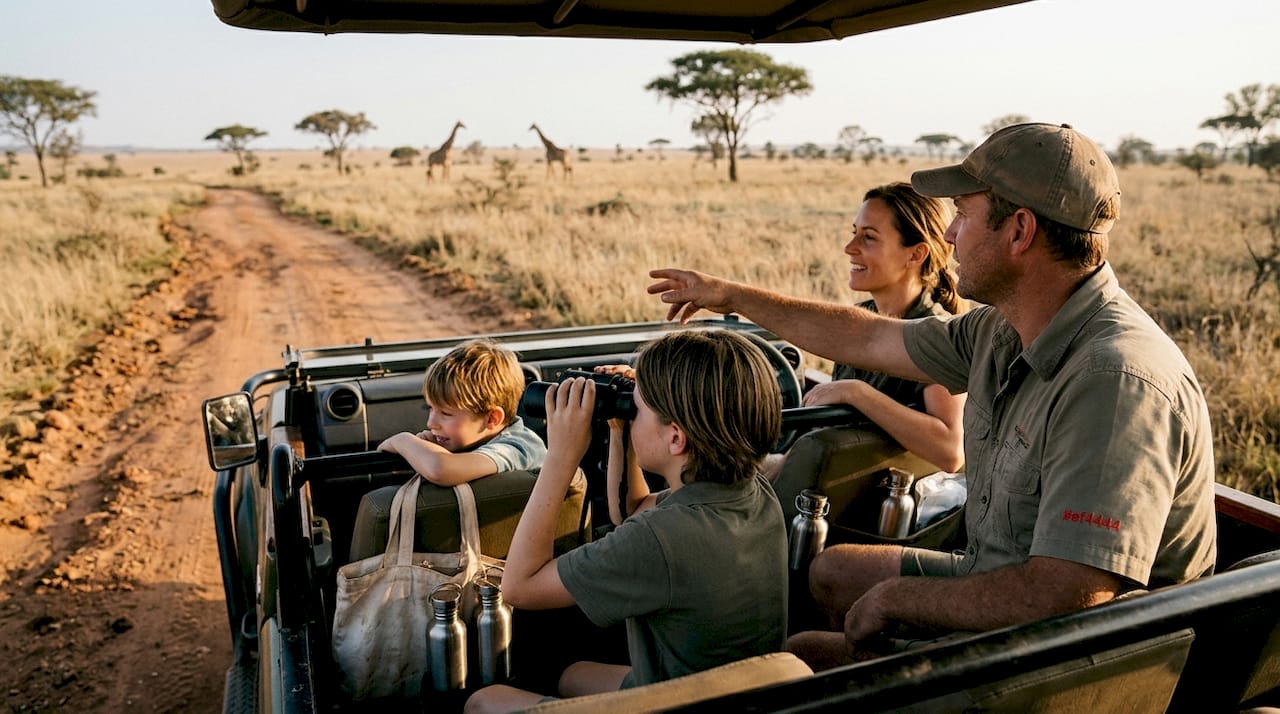
Think layers and neutrals. Mornings and evenings on safari are cold; middays are hot. Pack neutral, breathable clothing (avoid bright white and very dark blue/black, which attract insects in some areas), a warm fleece, a wide-brimmed hat, sunglasses, closed walking shoes, swimwear, and a light rain layer in green season. Add binoculars (one pair per person if you can, kids love their own), a good camera, chargers and adapters, insect repellent, high-factor sunscreen, and any medications in original packaging. Soft duffel bags, not hard cases, for light-aircraft trips. I send every family a full, personalised packing list for an African family safari for their exact route and season.
Travelling with children
This is what I do best. A few honest pointers: match the trip to the ages — some lodges have minimum-age rules and specialised family or private guiding; build in downtime so nobody burns out; and remember that shorter game drives, malaria-free options and interactive experiences (junior ranger programmes, tracking, cooking, community visits) often beat marathon wildlife days for younger kids. Multi-generational trips work beautifully when the pace suits everyone from toddlers to grandparents.
Visas and entry requirements
Most destinations are relatively easy to enter but the requirements differ country to country, and they do change. Several countries have moved to online travel authorisations you must apply for before you fly, so this is one to sort early rather than at the airport.
Many countries require your passport to be valid for at least six months beyond your travel dates and to have enough blank pages (two or more per country you visit). If you're crossing borders on a multi-country safari, each leg may have its own rules. When you travel with children, some countries, South Africa among them, can ask to see a full/unabridged birth certificate showing both parents, and a consent letter if a child is travelling with only one parent or a guardian.
| Destination | Typical system for many travellers | Sort it |
|---|---|---|
| Kenya | Electronic Travel Authorisation (eTA), applied online in advance | Before you fly |
| Tanzania (incl. Zanzibar) | eVisa online; Zanzibar requires proof of travel insurance | Before you fly |
| Uganda & Rwanda | eVisa online; East Africa Tourist Visa covers Kenya + Uganda + Rwanda together | Before you fly |
| South Africa | Visa-exempt for many nationalities (up to 90 days); others apply in advance | Check by passport |
| Namibia, Botswana, Zambia, Zimbabwe, Mozambique | Mix of visa-free, visa-on-arrival and e-visa depending on passport; Zambia/Zimbabwe offer a KAZA UniVisa on some routes | Check by route |
Requirements depend on your passport and your exact route and they can shift without much notice. I check every family's entry requirements as part of planning, flag the paperwork, and hand you a clear checklist with your journey pack.
Health and vaccinations
None of this should put you off. Millions of families travel to Africa healthy and happy every year. A little preparation makes it a non-event.
See a travel clinic or your GP 6–8 weeks before you go so that there's time for any vaccine courses. They'll provide advice based on your exact itinerary and your family's ages and medical history. Commonly discussed vaccines include routine boosters, Hepatitis A, and Typhoid. Yellow fever is the important one for cross-border safaris: several countries require a yellow fever certificate if you're arriving from or have recently passed through a country where it's present, so the order of your itinerary matters.
Malaria exists in many safari areas (parts of the Kruger, the Zambezi, the Serengeti and more), and the standard advice is antimalarial tablets plus good mosquito-bite prevention: repellent, long sleeves at dusk, and the nets your lodge provides. Reassuringly for families, some of the most-loved regions are malaria-free or very low risk, including Cape Town, the Garden Route, the Cape winelands and several private reserves, which makes them excellent choices for a malaria-free family safari with young children. A few practical extras: stick to bottled or filtered water in most areas and check with your lodge; pack a small family medical kit (rehydration sachets, child paracetamol, plasters, any prescriptions in original packaging with a copy of the script); and bring high-factor sun protection and hats, the African sun is stronger than it feels. We only use SPF 50 sun cream as a family.
I'll tell you which parts of your route carry a malaria risk and which don't, and I can build a malaria-free family safari if that's your preference.
Currency and banking
Each country has its own currency; South African Rand, Kenyan and Tanzanian Shillings, Namibian Dollar, Botswana Pula, and so on, and the US Dollar is widely accepted for tourism, park fees and tipping across much of the region.
Cards (Visa and Mastercard) work well in cities, hotels and larger restaurants; Amex less so. ATMs are reliable in towns and cities but sparse or absent in remote areas and safari camps so draw local cash before you head into the bush. Tell your bank you're travelling so your cards don't get frozen, and carry a backup card stored separately.
Tipping is customary and much appreciated for safari guides and trackers, lodge staff, drivers and porters.
For a realistic sense of what a trip costs, see my honest African family safari budget breakdown.
| Item | Guidance |
|---|---|
| Cards | Visa/Mastercard widely accepted in towns; Amex patchy |
| ATMs | Reliable in cities; scarce in remote/safari areas |
| Tipping | Expected for guides, trackers, lodge & hotel staff, drivers |
| Before you go | Notify your bank; carry a separate backup card |
Cultural etiquette and local customs
Africa is not one culture but hundreds, and part of the joy of travelling here is meeting them with curiosity and respect. A warm greeting goes a long way. Taking a moment to say hello and ask how someone is, before getting to the point, is the norm in most communities and never wasted.
A few gentle guidelines that serve families well: dress modestly in towns, villages and religious sites (Zanzibar and other Muslim-majority areas especially. Cover shoulders and knees away from the beach and pool). Always ask before photographing people, and respect a no. Be mindful around sacred sites and ceremonies. And when you visit a community or school, follow your guide's lead on gifts. Thoughtful, organised giving through the right channels helps far more than handing sweets or money to children directly.
Teaching your kids a few words of the local language, and encouraging them to greet people properly, turns them from tourists into guests. It's one of the loveliest things to watch on a family trip.
Every destination briefing I send includes the cultural notes that actually matter for that place such as what to wear, how to greet and what's considered polite, so your family arrives feeling like welcome guests rather than unsure visitors.
Safety and security
With sensible precautions, family travel across our destinations is safe and enormously rewarding. The wildlife areas and lodges I use are secure and expertly staffed, and the vast majority of trips pass without a single hiccup.
The practical advice is the same you'd use in any unfamiliar city anywhere in the world. Stay aware in busy urban areas, don't flash valuables or expensive phones, use hotel safes, and prefer arranged transfers over hailing rides off the street. Keep digital and paper copies of passports, insurance and key documents, stored separately from the originals.
On safari and around wildlife, the rules exist for good reason: stay in the vehicle unless your guide says otherwise, keep noise down, never feed or approach animals, and keep small children close and calm at all times. Your guide's word is final. Follow it and you're in some of the safest, most capable hands in the travel world.
I only work with lodges, camps and ground teams I know and personally vet, and every itinerary comes with 24/7 support. If anything feels off, day or night, you have a real person to call who can act on the ground.
In case of an emergency
First, the reassuring part: you will never be navigating a problem alone. Every Journey South family travels with our 24/7 support line and a full emergency contact card for your specific route — your lodges, ground handlers, the nearest medical facilities, your insurer's assistance line, and us.
If something serious happens, contact your hotel, lodge or guide first, they are trained, well-connected, and closest to the situation and call your travel insurance emergency assistance line, which coordinates medical care and, if ever needed, evacuation. Keep that number saved offline in every adult's phone and written on paper.
For local services, 112 works from most mobile phones across the region; in South Africa, police is 10111 and emergency services 10177. I include the correct local numbers for each country in your pack.
Keep your key documents backed up (email yourself copies, and store them offline), note your embassy or consulate details for longer trips, and make sure at least one person back home has your full itinerary.
| Step | Who to contact |
|---|---|
| 1 | Your lodge / guide / ground team. They are closest, trained and connected. |
| 2 | Your travel insurance emergency assistance line if medical evacuation is needed. |
| 3 | Journey South 24/7 support |
| 4 | Local emergency services — 112 from most mobiles; South Africa 10111 (police), 10177 (ambulance) |
Language
English is widely spoken across our destinations, particularly in tourism, hotels, lodges and cities, so you'll always be able to make yourself understood. Alongside it you'll hear a rich mix of local languages: Swahili across Kenya and Tanzania, and languages such as Zulu, Xhosa and Afrikaans in South Africa, among many others.
You don't need to be fluent in anything. But learning a handful of words such as hello, please, thank you and how are you, is one of the fastest ways to earn a smile, and it's a brilliant, low-pressure project for kids on the long flight over. "Jambo" (hello) and "Asante" (thank you) in Swahili, or a warm "Sawubona" in Zulu, open doors that no amount of tipping can.
Create a simple language cheat-sheet for the countries that you are visiting and share it with your children. It'll add extra flavour to your trip.
Local food and dietary requirements
Eating your way through Africa is a genuine highlight. Expect fresh, generous cooking: superb grilled meats and seafood, South Africa's world-class wines and its famous braai (barbecue), East African staples like ugali and nyama choma, fragrant Swahili-coast curries, and biltong your kids will beg you to bring home. Lodges and camps generally serve excellent, varied food, and standards at the properties I use are high.
Dietary requirements are very well handled - vegetarian, vegan, gluten-free, halal, kosher, nut and other allergies can almost always be catered for, provided I tell the lodges in advance. Remote camps buy supplies days ahead, so advance notice is essential. For fussy young eaters, don't worry: plain, familiar options (pasta, chicken, fruit, eggs) are the norm and staff are wonderful with children.
On the practical side: in most areas drink bottled or filtered water, be a little cautious with raw salads and street food if you have a sensitive stomach, and carry snacks for long game drives and transfers.
Tell us every allergy and preference in your family, however particular, when I plan your trip. I brief each lodge so the right food is waiting when you arrive, and no child (or adult) goes hungry.
Electricity, plugs and staying connected
Power: the region runs on 220–240V, so appliances from the UK, Europe, Australia and much of the world work fine, while US 110V devices need a voltage-compatible charger. Plug types vary, South Africa uses its own large three-pin socket (and increasingly a smaller two-pin type), while Kenya, Tanzania, Uganda and others use the UK-style three-pin. A good universal travel adapter solves all of it so bring two, plus a small power bank for game drives. Remote camps often run on solar or generator power with limited or scheduled electricity and few sockets, so charge devices whenever you can.
Connectivity: cities and most lodges have WiFi, though in the bush it can be slow, shared, or reserved to common areas (which many families quietly love). For reliable data, a local SIM or an eSIM is inexpensive and easy;
Download offline maps, boarding passes, entertainment for the kids and your emergency documents before you head somewhere remote.
| Item | What to expect |
|---|---|
| Voltage | 220–240V (US 110V devices need a compatible charger) |
| Plugs | South Africa: large 3-pin / newer small 3-pin · East Africa: UK-style 3-pin |
| Bring | Universal adapter (x2), power bank, charging cables |
| WiFi | Good in cities/lodges; slow or common-areas-only in the bush |
| Data | Local SIM or eSIM is cheap and reliable — sort on arrival |
Environmental and sustainable travel
Africa's wild places survive because tourism gives them value and the way you travel makes a real difference. I build trips around lodges and operators that genuinely reinvest in conservation and local communities, because I believe that family travel can matter.
You can travel lightly too. Bring a reusable water bottle (many lodges offer filtered refill stations), pack reef-safe sunscreen for coastal and marine trips, and say no to single-use plastics where you can. On safari, the ethics are simple: keep a respectful distance from the animals, never pressure a guide to get closer or off-road for a photo, don't feed wildlife, and take only pictures. Choose community experiences that pay local people fairly and are run on their terms.
"The big five & beyond" is our way of saying the best trips connect you to the whole place - its people, its landscapes and its future. We're happy to weigh your itinerary toward lodges and projects doing conservation properly. Just ask.
Travel insurance
Please don't travel without it. Comprehensive travel insurance is essential for every member of your family.
Make sure your policy clearly covers: emergency medical treatment and, critically, medical evacuation (in remote safari areas, evacuation can be by air and extremely costly without cover); trip cancellation and interruption; lost or delayed baggage; and any adventure activities your family plans (walking safaris, diving, quad biking, gorilla trekking and the like are sometimes excluded by standard policies, so check). Buy it before you pay the deposit, not just before you fly, so cancellation cover applies from day one. Read the age and pre-existing-condition terms carefully, especially for grandparents on multi-generational trips.
When to go and weather
Africa is a year-round destination, but timing shapes the trip. Broadly: the dry season concentrates wildlife around water and means easier game viewing and fewer mosquitoes, while the green season brings dramatic skies, newborn animals, superb birding and lower prices. Seasons differ by country and even by region, and they run opposite to the Northern Hemisphere — so \"summer\" in South Africa is December to February. Family school holidays are our busiest window, so the best lodges book out 6–12 months ahead; plan early. Tell us what you want to see and when you can travel, and I'll match you to the right place at the right time.
Flights, transfers and long-haul with kids
Getting to Africa often means a long-haul flight and one or two light-aircraft hops to reach camps. For the little ones: book overnight legs where you can, bring familiar comforts and downloaded entertainment, pack a change of clothes in hand luggage, and don't over-schedule day one. Light aircraft to safari camps have strict luggage limits (often ~15–20kg in soft bags) — I'll tell you the exact allowance so you pack right the first time. Car seats aren't guaranteed on transfers, so ask us in advance if you need one.
Packing essentials
Think layers and neutrals. Mornings and evenings on safari are cold; middays are hot. Pack neutral, breathable clothing (avoid bright white and very dark blue/black, which attract insects in some areas), a warm fleece, a wide-brimmed hat, sunglasses, closed walking shoes, swimwear, and a light rain layer in green season. Add binoculars (one pair per person if you can, kids love their own), a good camera, chargers and adapters, insect repellent, high-factor sunscreen, and any medications in original packaging. Soft duffel bags, not hard cases, for light-aircraft trips. I send every family a full, personalised packing list for an African family safari for their exact route and season.
Travelling with children
This is what I do best. A few honest pointers: match the trip to the ages — some lodges have minimum-age rules and specialised family or private guiding; build in downtime so nobody burns out; and remember that shorter game drives, malaria-free options and interactive experiences (junior ranger programmes, tracking, cooking, community visits) often beat marathon wildlife days for younger kids. Multi-generational trips work beautifully when the pace suits everyone from toddlers to grandparents.
Still have questions? That's what we're here for.
No web page can replace a proper conversation about your family and your trip. I plan for just a few families each month on purpose, so when you travel with Journey South, you get advice tailored to your children's ages, your must-sees, and the way you like to travel, plus 24/7 support the whole way. Ask us anything.